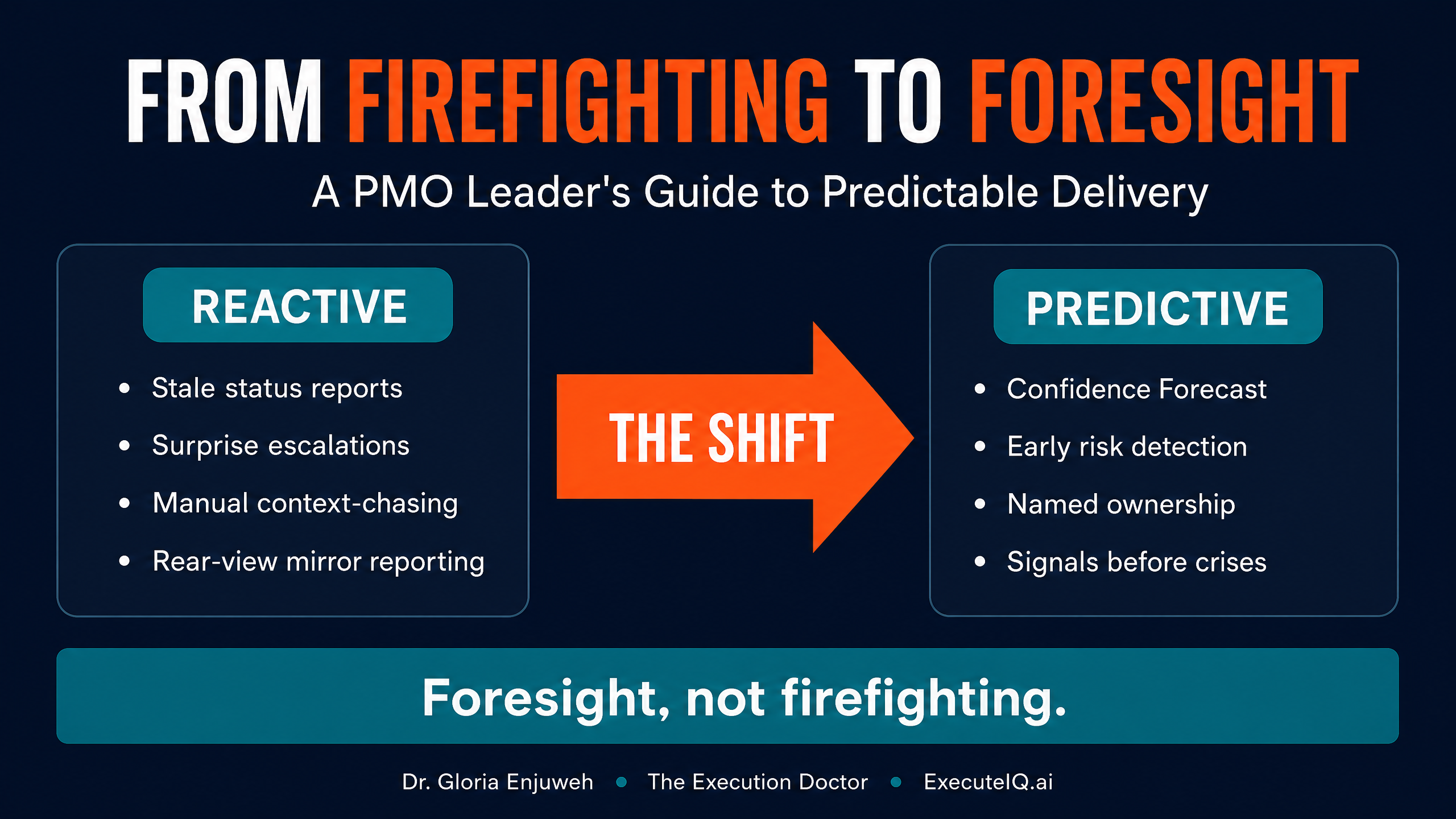
Ask any PMO Director what their team spends most of its energy on, and the honest answer is rarely delivery.
It is chasing updates. Rebuilding context. Reconciling status. Escalating what should have been escalated last week. Explaining to executives why a program is drifting when the signals were sitting in three different systems the entire time.
This is firefighting. And most PMOs have accepted it as the job.
It should not be.
What Firefighting Actually Costs
Firefighting is not an occasional interruption. In most delivery organizations, it is the operating model.
A PMO leader gets pulled into a Slack thread on Tuesday morning because a dependency slipped over the weekend. By Tuesday afternoon, they are rebuilding the context in a Confluence page for a stakeholder review. Wednesday is spent chasing action items from a steering committee that ran long because nobody had a current view of blockers. Thursday is triage on a program that turned red on the dashboard the same day the executive brief was due. Friday is status reports.
By the time the week ends, the PMO leader has responded to more crises than they have prevented.
This is not a discipline problem. It is a design problem. The PMO was built to see what happened. It was not built to see what is forming.
Research backs this up. Asana's Anatomy of Work Index found that knowledge workers lose 60% of the workweek to work about work, not to the skilled work they were hired to do. Inside a PMO, that lost time is exactly where foresight should be happening.
The Real Job of a PMO Is Foresight
The value a PMO creates is not in the report. It is in the insight that helps leaders act early.
A PMO that surfaces a slipping dependency on Monday prevents a missed milestone in three weeks. A PMO that flags a stalled decision in Slack prevents a two-quarter program delay. A PMO that connects a vendor risk to a strategic investment prevents a board conversation nobody wants to have.
Foresight is the actual job. Everything else is coordination overhead.
The problem is that most PMOs cannot deliver foresight because their tooling and processes were built for a different era, one where delivery signals lived inside a single system and updates traveled at the pace of weekly meetings.
That era is over. Delivery today is distributed across Jira, Confluence, Slack, Microsoft Teams, documents, and meeting transcripts. The signals still exist. They are just fragmented across the stack.
Five Shifts That Move a PMO From Reactive to Proactive
A shift from firefighting to foresight is not a single change. It is a series of operational moves that compound over time.
1. Move from status reporting to signal reporting.
Most status reports summarize what already happened. Signal reports surface what is forming. Instead of "the program is 42% complete," a signal report says "the dependency on Legal has slipped twice in the last two weeks and is now on the critical path." One is history. The other is action. The format that makes this operationally useful is a Confidence Forecast: target, confidence percentage, top driver, and next check. It replaces static status with a structured view of whether the outcome is protected, and what would change the answer.
2. Move from weekly cadence to real-time context.
Weekly status meetings assume that a week's worth of signal can be safely delayed. It cannot. A blocker that surfaces in Tuesday's Slack thread should be visible to the PMO on Tuesday, not surfaced in Friday's report. Real-time context is not about more meetings. It is about not waiting for meetings to know what is changing.
3. Move from tool-by-tool triage to unified visibility.
The PMO leader who checks five tools to answer one question is the PMO leader who cannot scale. Unified visibility means one view across every tool, chat, meeting, and document, so the question "what is blocking us?" can be answered without a two-hour audit.
4. Move from manual escalation to named ownership.
Escalations that live in an executive's head are not escalations. They are anxiety. A proactive PMO surfaces risks with named ownership, recommended next steps, and the outcome they affect. The escalation becomes a decision request, not a fire drill.
5. Move from activity metrics to outcome metrics.
Most PMOs report on activity: tickets closed, meetings held, updates published. Executives care about outcomes: are we hitting the quarter, is the investment protected, is the strategic bet paying off. The shift from activity to outcome metrics is what turns a PMO from a reporting function into a strategic function.
What This Looks Like When It Works
A PMO operating in this model looks different from the outside.
Weekly status meetings are shorter, because the room already has the picture before the meeting starts.
Executive briefs are on demand, not on a schedule, and they focus on decisions rather than updates.
Risks surface with recommendations, not just red indicators.
The PMO Director is no longer the person who chases updates all week. They are the person who protects strategic investments by seeing signals early.
That is what foresight looks like operationally. It is not a philosophy. It is an operating change.
Why This Shift Is Hard
Most PMOs know this. The reason the shift has not happened is not vision. It is architecture.
Existing PM tools were designed to manage structured work, not to reason across the fragmented context where signals actually live. Adding an AI assistant inside one tool does not close the gap. Neither does more manual coordination, more templates, or a heavier reporting cadence.
The shift from firefighting to foresight requires a different kind of layer, one that unifies structured and unstructured context across the delivery stack and reasons over it in real time.
That is what ExecuteIQ is being built for.
The PMO Of The Future
The PMO of the future is not a bigger PMO. It is a smaller, sharper, more strategic one.
It spends less time coordinating and more time deciding. It sees earlier, escalates faster, and connects execution to outcomes without translating between five systems and four audiences.
It stops explaining why things went wrong and starts protecting what has to go right.
The organizations that make this shift first will not just deliver more projects on time. They will free their most experienced PMO leaders to do the work only they can do: safeguard strategic investments, coach teams under pressure, and make sure the organization moves faster than its complexity.
That is the real value of a modern PMO.
Foresight, not firefighting.
Dr. Gloria Enjuweh | Founder & CEO, ExecuteIQ | The Execution Doctor
executeiq.ai | LinkedIn
References
Anatomy of Work Index, Asana. Survey of 13,000+ knowledge workers across the U.S., U.K., Australia, Japan, Germany, and France. asana.com/resources/anatomy-of-work