The pitch for agentic AI in delivery is easy to make and hard to argue with in the abstract.
Autonomous agents will read your Jira. They will attend your meetings. They will draft your status reports, chase your blockers, escalate your risks, and eventually run entire programs while your team focuses on higher-value work.
It is a compelling story. And in narrow domains, some version of it is already working. Devin can generate code. Coding agents can close well-scoped tickets. Meeting bots can produce serviceable summaries.
But the story that agentic AI will absorb enterprise delivery breaks down inside almost every mid-market and large organization that tries it. Not because the technology is bad. Because the architecture is dishonest.
What Agentic AI Actually Does Well
Before critiquing, it is worth naming what agentic AI genuinely does well.
It handles bounded tasks with clear inputs and outputs. It executes deterministic workflows where the definition of success is unambiguous. It performs well when the domain is narrow, the data is clean, and the stakes of any single decision are low enough that a bad output is a small cost to bear.
Code generation fits this profile. Structured data entry fits it. Some kinds of research and summarization fit it.
These are real wins. Delivery organizations should absolutely use agentic AI for the tasks where it works.
The problem is the conflation of "works in narrow tasks" with "will work in enterprise delivery." The gap between those two claims is where most agentic AI pitches quietly fall apart.
Where Agentic AI Breaks in Enterprise Delivery
Enterprise delivery is not a narrow domain. It is the coordination layer across dozens of tools, hundreds of stakeholders, thousands of decisions, and a level of context complexity that no autonomous agent has yet been shown to handle reliably.
Four specific failure modes recur.
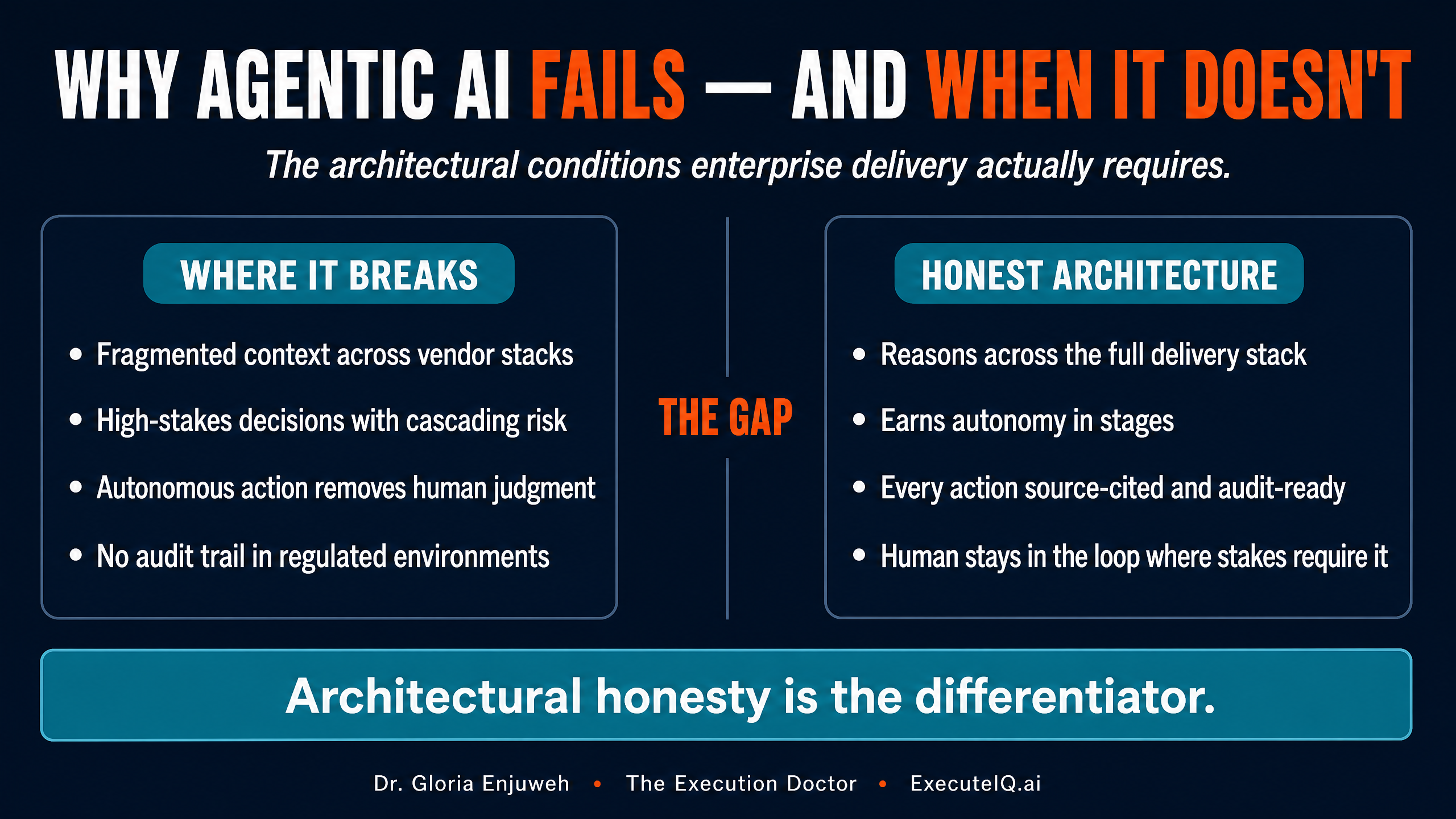
1. The context is fragmented across systems the agent cannot fully reason across.
An agentic AI built inside Atlassian's ecosystem, like Rovo, is architected around Jira and Confluence. An agent built inside Microsoft's ecosystem, like Copilot, is architected around Teams and SharePoint. Both have third-party connectors, but their defaults, pricing, and roadmap incentives favor their parent stack — which means the depth of reasoning is uneven the moment you cross vendor lines, plus Slack, plus documents, plus meeting transcripts, plus the vendor conversation that happened over email.
The agent's reasoning is only as good as the context it can see. In enterprise delivery, no single agent sees the whole picture, and the pieces it misses are usually the pieces that predict risk.
2. The stakes of a single wrong action are too high.
A code generation agent that ships bad code costs an hour of engineering time. An agent that escalates the wrong risk to a CFO, misses a slipping dependency, or reassigns work without understanding the political context of the reassignment costs relationships and credibility.
Delivery is high-context, high-stakes coordination. The failure modes are not "one bad output" — they are cascading trust erosion, and they do not surface for weeks.
3. Autonomous action removes the human from the decision they still own.
Enterprise delivery decisions are not just informational. They are political, strategic, and relational. A PMO leader who lets an agent send an executive brief has abdicated a judgment call that only they can make, because only they know how the CFO reads brief tone, how the CTO responds to risk framing, and what happened in the last three unrecorded conversations.
Autonomous agents are architected to remove the human from the loop. In delivery, the human is the loop.
4. Traceability breaks the moment the agent acts on its own.
Enterprise buyers, especially in regulated industries and federal environments, require full auditability. Every decision, every action, every escalation must be traceable back to a source and a sanctioned actor.
Agentic AI that takes autonomous action without a clean, exportable audit trail is a compliance problem waiting to be discovered. Most current implementations do not meet the bar. Some cannot meet it at all without architectural rebuilds.
The Architectural Conditions For Agentic AI To Actually Work
None of the above means agentic AI has no role in enterprise delivery. It means the current implementations are architecturally dishonest about what they can do.
Four conditions would have to be met for agentic AI to work at delivery scale.
First, the agent must reason across the entire delivery stack, not just one vendor's ecosystem. Structured data (tickets, dependencies) and unstructured context (meeting transcripts, chat threads, documents, decisions) both matter, and the agent has to see both, equally, across every tool.
Second, the agent must earn autonomy in stages, not claim it upfront. Recommendation is a lower bar than action. Suggestion is a lower bar than execution. An honest system starts by surfacing what a human should decide, then earns the right to act by demonstrating consistent judgment over time.
Third, every action must be source-cited and audit-ready. Every recommendation traces to the ticket, message, document, or transcript that produced it. Every action is logged and exportable. No black box. No unrecoverable decisions.
Fourth, the human stays in the loop where the stakes require it. Agentic AI in delivery is not about replacing PMO leaders and executives. It is about giving them a system that surfaces the signals, drafts the artifacts, and reduces the coordination tax, so the human decisions that only they can make get made faster, with better inputs, and with the full context of the organization.
These four conditions are not exotic. They are what "honest architecture" looks like in enterprise delivery. Most current agentic AI implementations meet one or two. Very few meet all four.
Why This Matters For Delivery Leaders
Delivery leaders are being sold two contradictory stories right now.
One story says agentic AI is about to replace their teams and their role. The other says agentic AI is dangerous, unreliable, and should be resisted.
Both stories are architecturally lazy. The honest answer is more useful.
Agentic AI has a real role in enterprise delivery, but not the one the pitch decks describe. Its role is not to run programs autonomously. Its role is to eliminate the coordination overhead that keeps senior delivery leaders trapped in firefighting, so those leaders can spend their time on the judgment calls, escalations, and strategic decisions that no agent will be trusted to make for a long time, if ever.
The delivery leaders who understand this distinction will not lose their jobs to agentic AI. They will use it to become sharper, faster, and more strategic — while the leaders who fall for the autonomous-agent pitch will spend the next three years explaining why the agent shipped the wrong brief to the wrong executive at the wrong time.
Architectural honesty is the differentiator. Between the AI that reasons across your entire delivery stack and the AI that reasons across one vendor's slice. Between the AI that recommends and the AI that acts without accountability. Between the AI that keeps you in the loop and the AI that removes you from it before it has earned the right.
The pitch decks are catching up. The architecture is not.
Foresight, not firefighting.
Dr. Gloria Enjuweh | Founder & CEO, ExecuteIQ | The Execution Doctor
executeiq.ai | LinkedIn