Every delivery leader knows the feeling.
It is Thursday afternoon. The Friday status report is due. Jira has the ticket movement. Confluence has the decision history. Microsoft Teams or Slack has the conversation. A document has the steering update. The most important context may be buried in meeting notes, a comment thread, or a follow-up that never made it into a formal field.
So the work begins again: copy, paste, reconcile, reformat, chase, summarize, and translate.
That is the admin tax: the hidden cost of keeping execution visible when the work itself is scattered across too many systems, conversations, documents, and meetings.
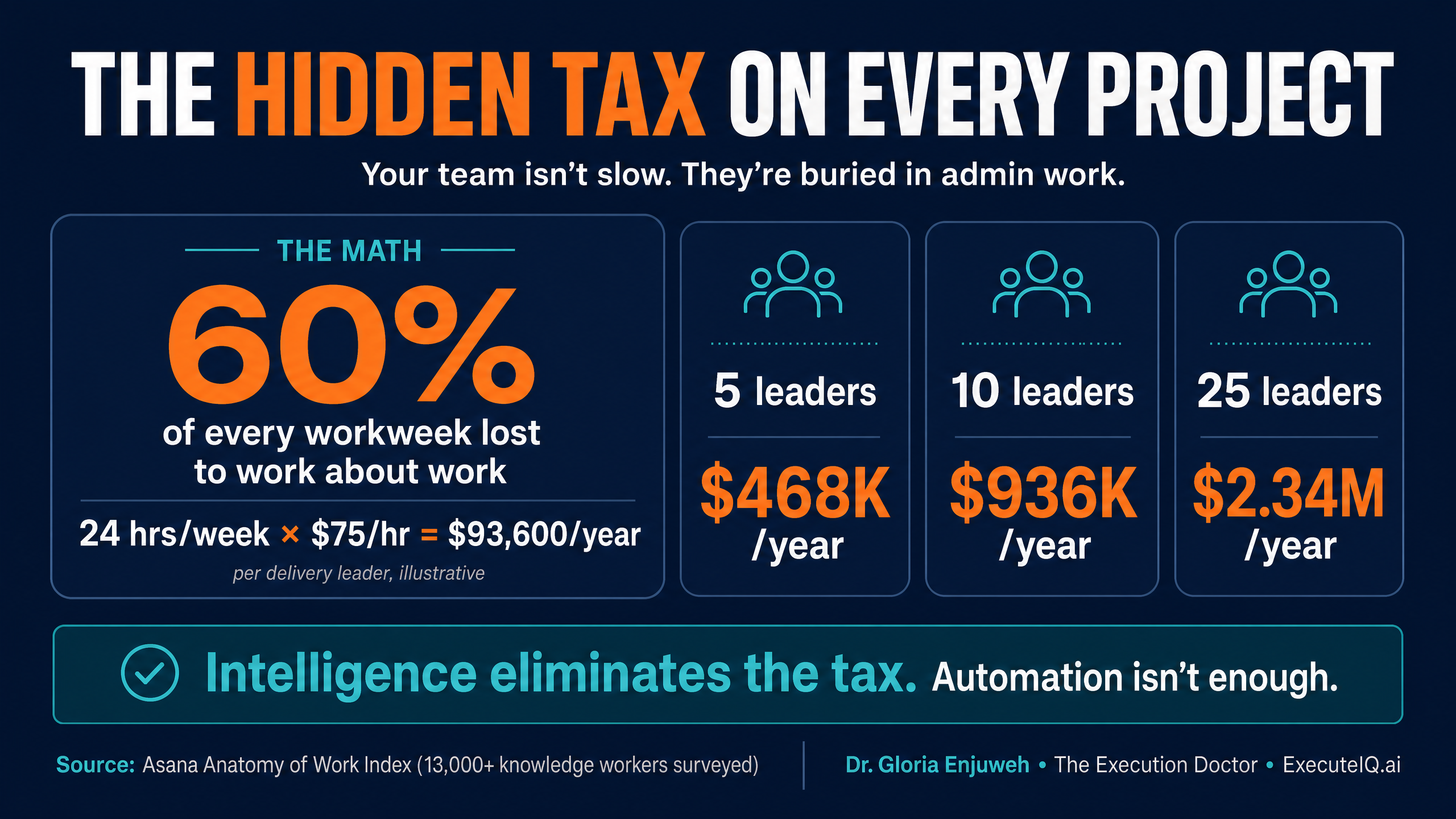
60%
of every workweek lost to "work about work"
Asana's Anatomy of Work Index 2021 found that knowledge workers spend 60% of their day on "work about work" rather than the skilled work they were hired to do. The study analyzed more than 13,000 knowledge workers across Australia, France, Germany, Japan, Singapore, the U.K., and the U.S.
That number is not a project-management statistic. It is broader than that. But inside a delivery organization, it has a very specific shape.
It looks like status reports. RAID logs. Dependency follow-ups. Meeting prep. Executive summaries. Tool reconciliation. Manual updates. Rewriting the same delivery story five different ways for five different audiences.
The Problem Is Not That Delivery Teams Do Not Work Hard
Delivery leaders are not short on effort. PMO Directors, Program Managers, Project Managers, Agile Coaches, Scrum Masters, Engineering Managers, Product Managers, and Delivery Managers spend enormous time trying to create clarity from fragmented signals.
Executives feel the same problem from the other side. CIOs, CTOs, COOs, VPs, and portfolio leaders need a trusted view of what is on track, what is drifting, and what requires intervention. But too often, that visibility arrives late, after the team has already spent hours converting delivery activity into executive-ready language.
The result is not just inefficiency. It is an execution drag.
| Admin activity |
Why it consumes time |
What leaders actually need |
| Status reporting |
Updates are rewritten, reformatted, and reconciled across teams. |
A concise view of confidence, risk, and next action. |
| RAID logs |
Risks, assumptions, issues, and dependencies are often maintained manually. |
Early signal detection and source-backed escalation. |
| Executive briefs |
Delivery teams translate operational detail into business language by hand. |
Portfolio-level execution intelligence tied to outcomes. |
| Dependency tracking |
Cross-team blockers live in tickets, chats, meetings, and documents. |
A connected view of what is waiting on what. |
| Meeting prep |
Teams reconstruct context before every governance conversation. |
Full project memory that does not reset every week. |
The admin tax grows because delivery work does not live in one place. Jira may hold the backlog. Confluence may hold decisions. Microsoft Teams or Slack may hold the conversation. Documents may hold meeting notes, steering updates, or business context. The most important signal is often not in the official status field.
The Math Makes the Tax Visible
If 60% of a standard 40-hour week is consumed by work about work, that is roughly 24 hours per week spent coordinating, searching, switching, reporting, and reconstructing context.
Using a simple illustrative rate of $75 per hour, the annual cost becomes difficult to ignore.
| Team size |
Illustrative annual admin cost |
| 1 delivery leader |
$93,600 |
| 5 delivery leaders |
$468,000 |
| 10 delivery leaders |
$936,000 |
| 25 delivery leaders |
$2.34M |
This is not a labor-cost story. It is an opportunity-cost story. Every hour spent on manual coordination is an hour not spent coaching teams, removing blockers, escalating the right risks, prioritizing tradeoffs, or connecting execution to business outcomes.
For a 10-person PMO, the math can approach nearly a million dollars a year in skilled labor spent compiling, formatting, chasing, and rebuilding context before a single better decision is made.
Status Reporting Is a Symptom, Not the Disease
Status reporting gets blamed because it is visible. But the deeper problem is not the report. The deeper problem is the manual reconstruction required before the report can exist.
MIT Sloan Management Review has written about the risks of traditional project status reporting, especially in complex IT projects where executives can be surprised by problems that were developing long before launch. The issue is not merely that teams report late. It is that the reporting process often depends on selective, fragmented, or delayed human interpretation.
That creates two risks at once. Delivery teams lose time preparing updates, and executives lose confidence that the updates reflect what is really happening.
The admin tax is not only an operational problem. It is a leadership confidence problem.
Why Automation Has Not Fixed It
The natural assumption is that automation should have solved this years ago. Most delivery tools now include templates, scheduled exports, integrations, triggers, workflow rules, and summaries.
Those features help. But they do not eliminate the tax because the tax is not only the movement of data.
It is the interpretation of context.
A status report template can move ticket data into a formatted document. It cannot reliably tell which tickets matter this week, which risks are forming in the conversations around those tickets, which decision from Tuesday's meeting changes the plan, or which dependency is about to slip because of something said in a call.
Automation moves data. It does not create judgment.
That is why the human stays in the loop on every report, every brief, every update, and every escalation. The tool can move the information, but the delivery leader still has to assemble the story by hand.
Automation is useful. It is not sufficient.
What Reducing the Admin Tax Requires
Reducing the admin tax requires more than another place for teams to type updates. It requires more than templates. It requires more than faster copy-paste.
It requires a vendor-neutral execution intelligence layer that sits above the existing delivery stack, connects structured and unstructured context, and turns fragmented signals into source-backed intelligence.
For ExecuteIQ, that starts with the tools delivery teams already use. V1 begins with Jira, Confluence, Microsoft Teams, Slack, and uploaded documents. The broader architecture is built for the reality of mixed-vendor enterprise delivery, where the system of execution is not one tool, one vendor, or one repository.
| Requirement |
Why it matters |
| Vendor-neutral architecture |
Delivery work spans Atlassian, Microsoft, Slack, documents, and other systems already in use. |
| Structured and unstructured data unification |
Risks often appear in comments, meeting notes, decisions, and conversations before they appear in formal fields. |
| Full project memory |
Leaders need persistent context, not weekly reconstruction. |
| Predictive execution intelligence |
The goal is to surface what is changing early enough to act. |
| Source citations |
Trust depends on showing where the signal came from. |
This is the shift from administrative reporting to predictive execution intelligence.
Intelligence Eliminates the Tax. Automation Is Not Enough.
The future of delivery leadership will not be defined by who can collect the most updates. It will be defined by who can reduce the noise, preserve the context, and surface the signals that matter before they become escalations.
That is the work ExecuteIQ is built for.
Working across the delivery stack. Reducing administrative work. Helping PMOs move beyond manual reporting factories.
A vendor-neutral predictive execution intelligence layer across the tools teams already use, so delivery leaders and executives can move from status-chasing to confident action.
The admin tax has been accepted as normal for too long.
It is not normal. It is a design problem.
And design problems can be fixed.
Foresight, not firefighting.
Dr. Gloria Enjuweh | Founder & CEO, ExecuteIQ | The Execution Doctor
executeiq.ai | LinkedIn
Ready to Eliminate the Admin Tax?
Be among the first to get foresight, not firefighting.
Join the Waitlist