There is a number every delivery leader should know.
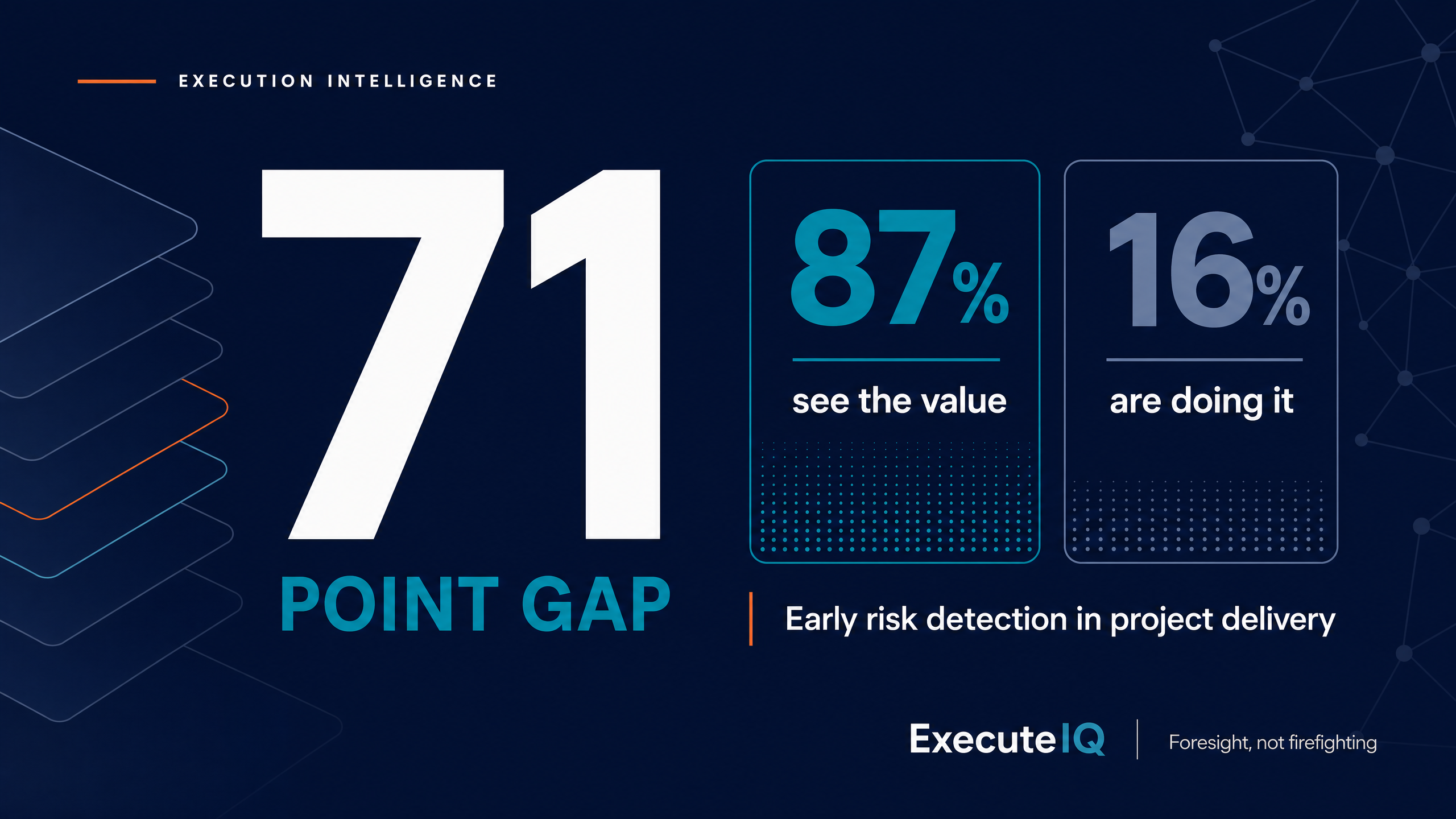
71
The gap between demand and reality in early risk detection
That is the gap, in percentage points, between the number of respondents in Digital.ai's 18th Annual State of Agile Report who say AI would help them detect delivery risks or quality issues earlier and the number of current AI users who say they are already using AI to identify or reduce risks earlier in delivery.
87% see the value. 16% are doing it.
That is not a small adoption lag. It is a signal that the market understands the need, but most organizations still do not have the operating model, data foundation, or execution intelligence layer to solve it.
What Early Risk Detection Actually Means
Before going further, it is worth being clear about what delivery leaders are asking for when they say they want early risk detection.
They are not asking for another red-amber-green status indicator. By the time a status turns red, the damage is often already in motion. That is not detection. That is delayed visibility.
They are also not asking for abstract predictive analytics that requires perfect data hygiene, months of modeling, and a separate data science team to interpret the output. Most delivery organizations do not need a black box. They need earlier signal from the work already happening.
They want to know what is forming before it fully forms. They want the conversation in Slack or Microsoft Teams to reveal that a dependency is slipping before the ticket turns red. They want the meeting note that says "we are still waiting on legal" to surface as a blocker before it becomes a missed milestone. They want a decision buried in Confluence or an uploaded document to connect back to the work it affects.
The signal usually exists. It is just scattered across the delivery stack.
The Gap Is Structural, Not Just Technical
The natural assumption is that the 71-point gap exists because the technology is not advanced enough. That is not the full story.
The deeper issue is structural.
Most delivery tools were designed to record structured data: tickets, tasks, dates, owners, milestones, comments, and status fields. But many of the signals that predict delivery risk live in unstructured context: meeting notes, chat threads, document comments, stakeholder decisions, sentiment shifts, unresolved escalations, and dependency conversations.
So when leaders ask, "What is at risk?" the answer is limited by what the system can see.
| Where risk often appears first |
Why structured tools miss it |
| Chat threads and team conversations |
The signal is conversational, not a formal status update. |
| Meeting notes and transcripts |
Decisions and blockers are captured, but not always connected back to work. |
| Documents and comments |
Context changes, but the delivery plan may not update with it. |
| Tickets and work items |
Structured data shows the record, but not always the reason behind the risk. |
This is why more tooling does not automatically create foresight. A tool can only reason from the context it can access, connect, and trust.
Digital.ai's report reinforces the point: AI cannot accelerate delivery if the underlying data is not connected, trusted, and reasoned over with context.
You Cannot Summarize Your Way to Foresight
A lot of AI in delivery is still focused on summarizing what already happened. That has value, but it does not close the 71-point gap.
A summary can tell a leader what was said in a meeting. It does not automatically connect that comment to a dependency, milestone, customer commitment, executive priority, or confidence forecast. A status report can describe last week's progress. It does not automatically surface the weak signal that should change this week's plan.
This is the difference between reporting and foresight.
Reporting explains the past. Predictive Execution Intelligence identifies what is forming, what is driving confidence up or down, and where intervention will matter.
Why This Matters for PMOs and Executives
For PMOs, program leaders, portfolio leaders, and executives, the 71-point gap should be uncomfortable.
Digital.ai reports that organizations are under rising pressure to connect delivery work to measurable business outcomes. That means early risk detection is no longer just a delivery-team problem. It is an executive confidence problem.
When risk is detected late, strategic investments slip without enough warning. Decisions wait on context that lives in conversations no one has time to read. Status updates become less trusted. Leaders start running parallel intelligence channels because the formal reporting system no longer feels reliable.
That is the real cost of the gap. It is not just missed dates. It is decision latency, duplicated follow-up, executive uncertainty, and preventable escalation.
What Closing the Gap Requires
Closing the 71-point gap requires more than another AI assistant inside a single tool. It requires an execution intelligence layer across the delivery stack: one that can reason across both structured and unstructured context, regardless of where that context lives.
That layer has to work with the tools teams already use across their existing delivery stack. In V1, that means Jira, Confluence, Microsoft Teams, Slack, and uploaded documents. Architecturally, the point is broader: delivery intelligence should not be trapped inside one vendor ecosystem or one system of record. It has to unify scattered context wherever work, decisions, blockers, and updates already live.
It also has to surface the 22% that matters instead of adding more noise. It has to cite its sources so delivery leaders and executives can trust the insight. And it has to translate risk into a format leaders can act on: target, confidence percentage, top driver, and next check.
That is the difference between asking for another update and receiving a Confidence Forecast.
Where ExecuteIQ Comes In
ExecuteIQ sits above the delivery stack as a vendor-neutral predictive execution intelligence layer. It works with the tools teams already use, unifying scattered context, building full project memory, and surfacing early signals before they become fires.
The 71-point gap has been open long enough.
The future of delivery leadership will not be defined by who collects the most updates. It will be defined by who can see what is coming early enough to act.
Foresight, not firefighting.
Dr. Gloria Enjuweh | Founder & CEO, ExecuteIQ | The Execution Doctor
executeiq.ai | LinkedIn
Ready for Predictive Execution Intelligence?
Be among the first to get foresight, not firefighting.
Join the Waitlist